Mars: The Inauthenticity of Western Boom Town Main Streets
In Forgotten are the Locals: Structures of Common Differences and the Inauthentic Curation of Western Boom Town Main Streetscapes, Matthew M. Mars (Public and Applied Humanities, University of Arizona) examines four rural Arizona “main street” streetscapes to better understand how these structures function as inauthentic representations of everyday rural life.
In Western American towns, main streets hold both historical and symbolic significance in rural American identity. They are also a focus of rural economic development plans which prioritize tourism. This is especially true in the American West, where tourists are drawn by imagery of rugged individualism and free spiritedness. However, in these same towns rural Americans are facing shrinking economies and populations coupled with inadequate health and education systems.
Focusing on this dichotomy, Mars argues that these main street streetscapes obscure the problems faced by rural communities by presenting what he calls a “curated inauthenticity.” He argues that authenticity requires “alignment of material form and social function” which is not achieved by these streetscapes. Mars visited and photographed main streets in four tourism-oriented rural towns in Arizona. In all four, he found misalignment between the exterior of the buildings and their interior purpose. The buildings featured western architecture and history on the outside while the interior catered to tourists with high-end boutiques, coffee shops and bistros, and fine art galleries. These main streets rarely function as gathering spaces for local residents, who instead rely on chain retailers, strip malls, and dollar stores. This study uses a qualitative methodology that combines photo analysis with the theoretical framework of “Structures of Common Difference” (SCD), which identifies globally homogenous patterns across otherwise localized contexts. All four main streets revealed a common schematic, creating a “common visual narrative along and across four otherwise standalone public spaces.”
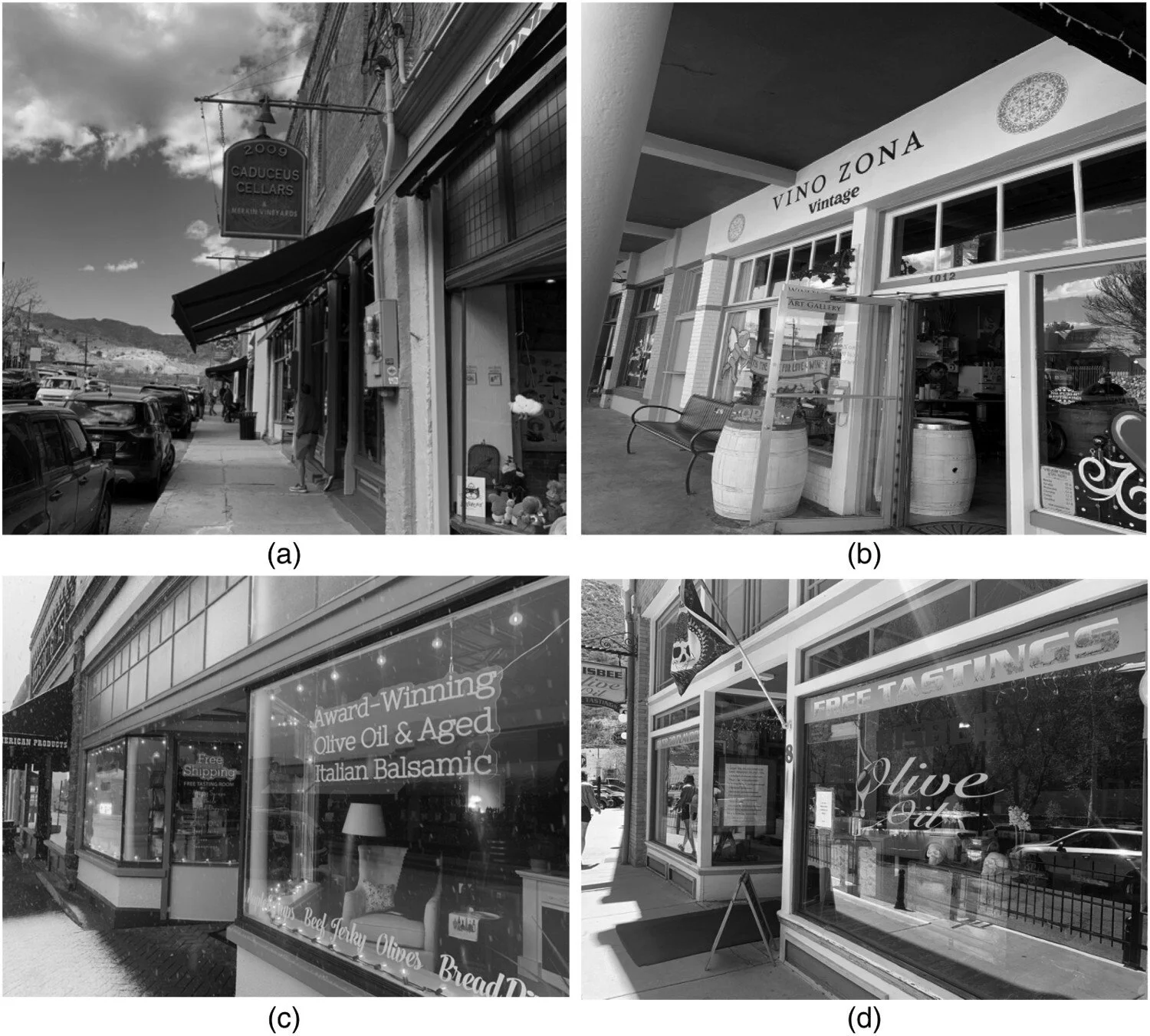
Image from article: Historic boom town main streetscape SCD as seen between wine tasting rooms in Jerome (left) and Cottonwood (right). Historic boom town main streetscape SCD as seen between gourmet oil olive shops in Williams (left) and Old Bisbee (right).
Ultimately, Mars argues these main streets are inauthentic curations of nostalgic expectations of the American West which are both physically and symbolically disconnected from contemporary rural life. The streetscapes reflect a form of rural gentrification in places already facing significant social and economic challenges. Mars suggests that combining photo analysis with the SCD framework might help future research to better understand and recognize these kinds of patterns of curated inauthenticity in other vulnerable communities.