Book Review: The Farmer’s Lawyer
Book Review and Commentary by Hannah Haksgaard.
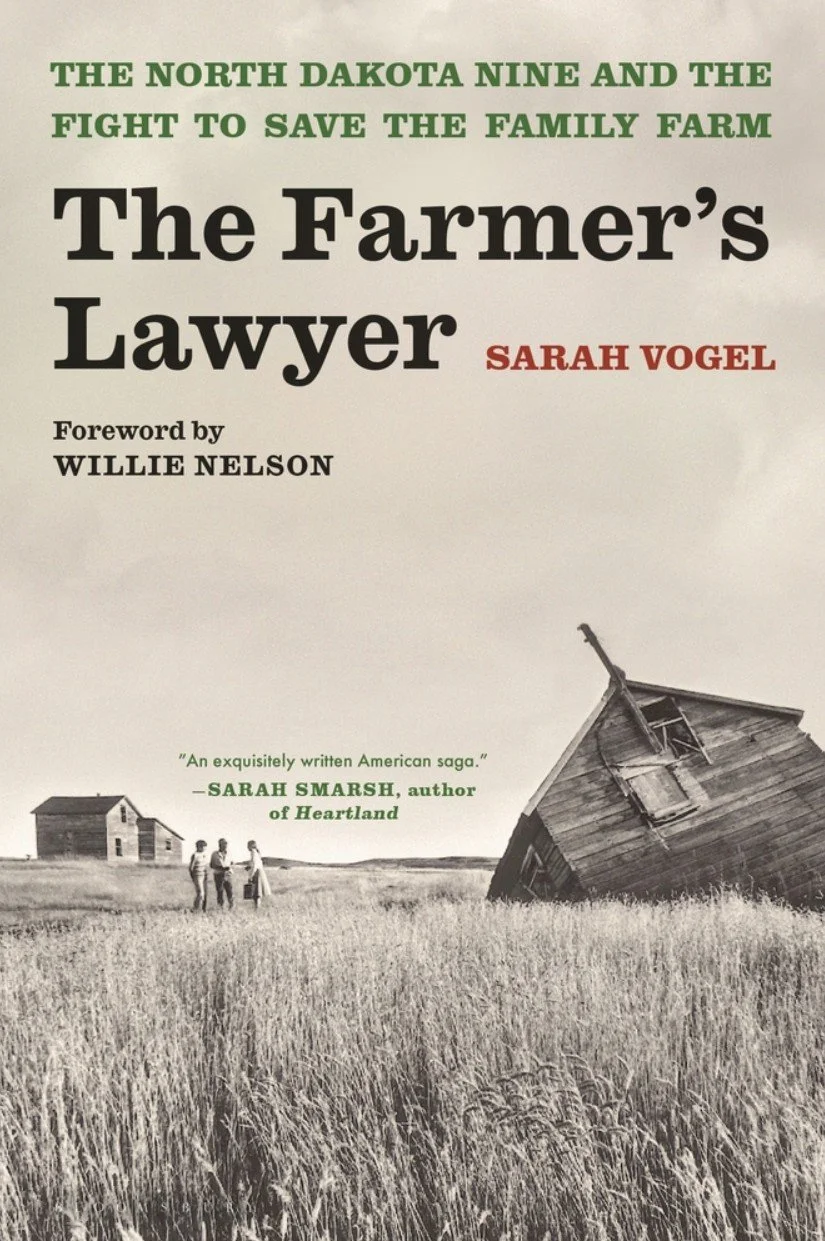
Hannah Haksgaard shares this review of Sarah Vogel’s The Farmer's Lawyer: The North Dakota Nine and the Fight to Save the Family Farm (Bloomsbury, 2021)
Sarah Vogel’s The Farmer’s Lawyer: The North Dakota Nine and the Fight to Save the Family Farm covers litigation from the farm crisis of the 1980s. Vogel begins by declaring the book to be “a memoir of a lawsuit I brought against the federal government.” The Farmer’s Lawyer is indeed a memoir, but it is also so much more. Vogel shares her personal recollections of litigating Colman v. Block while simultaneously telling an in-depth and well-researched narrative of the federal government’s role in farm foreclosures in the 1980s.
In The Farmer’s Lawyer, the writing is strong and the details are extensive. While reading, I would occasionally flip to Vogel’s sources at the back of the book. The sources are—in a word—impressive. If a historian ever wanted to read primary sources on farm foreclosures in the 1980s, Vogel’s notes would provide a stellar starting point. The Epilogue reveals how Vogel found her sources: she had saved them herself. While litigating Colman, she set aside documents and boxed them up at the end. I’m glad she saved it all. Without the boxes of paper records, and her fortuitous decision to obtain the federal court records mere months before their scheduled destruction, The Farmer’s Lawyer would read more like a mere memoir. But by drawing directly from the source materials, Vogel enhances the story with direct quotations preserved in newspaper articles and court records.
Add to that the historical images, mostly photographs and political cartoons, and the book really brings the story to life. For example, when describing how she brought a class action lawsuit and her travels around rural North Dakota to meet farmers, Vogel includes photographs of the named plaintiff—Dwight Coleman—on his land in the Turtle Mountains. One photo even shows Coleman standing next to Vogel as they look at cattle, Vogel looking so very, very young. The images of Vogel at work in rural places ground the reader in the geographical context of the book. Add in the photographs of small-town offices and meeting halls, and the reader is reminded exactly how rural, remote, and often poor these farm communities really were. Throughout the book, the source materials give the reader a sense of time and place that adds important context.
Context was, at least for me, an important part of my reading experience. I was born in the late 1980s, after the events of this book. Of course, I knew there had been a farm crisis in the 1980s, just like I was aware of the Great Depression. But I have no first-hand knowledge of what happened. The South Dakota farms in my own family were lost during the Great Depression, so by the time the 1980s rolled around, none of my ancestors still had land to lose. We were solidly town-folks by that point, and the 1980s farm crisis was not something discussed in my own family during my childhood. An impressive aspect of Vogel’s book is that she was able to provide (even to an uninformed reader like me) a real sense of what it felt like to live through this foreclosure crisis. Certainly, the photographs help in portraying this. But equally important is Vogel’s ability to weave together the individual stories of her clients with the broader context of the farm crisis. Throughout the book, the reader gets to know some of the clients, not just as parties to a lawsuit, but as people living full lives while managing farms, families, loans, and a lawsuit.
The Farmer’s Lawyer is a rare legal memoir which creates suspense and excitement about the case itself. Vogel provides a narrative story arc that leaves the reader on the edge of their seat not only to learn the outcome of the case but also to see the legal arguments unfold. The book is divided into four parts, titled The Sowing, The Growing, The Reaping, and The Saved Seed. The four parts walk the reader chronologically through the case, building suspense along the way. Lawyers will appreciate the details on legal arguments about constitutional due process rights, foreclosure laws, class actions, and federal agency operations. But non-lawyers will find it accessible. Throughout the book, Vogel is good at defining and explaining legal terms and ideas.
Today’s readers—whether lawyers or not—will undoubtedly notice the parallels between Vogel’s story and the political environment of the current moment. The implementation of Reagan’s Grand Doctrine has parallels with Trump’s DOGE. The mechanics of a single district court issuing a nationwide injunction recently came before the Supreme Court in Trump v. Casa. Inflation spiked after the COVID-19 pandemic, just as it did before the 1980s farm crisis began. In turn, just like in the 1980s, interest rates have risen (though not nearly to the rate of the 1980s) and those rates are now impacting farmers’ abilities to afford loans.
One thing the book does not include is what researchers have said about Colman v. Block in the decades since it was decided. There is no section that contemplates how often the case has been cited in other courts or, say, whether academics have tried to figure out how much the case changed the rate of farm foreclosures. But these omissions are entirely appropriate. Vogel, after all, set out to write her memoir. It is for others to pick up these retrospective questions. Particularly with all of the parallels to the modern day, perhaps now is the time for an academic to investigate these questions. Just as Vogel drew inspiration from the responses to the Great Depression, the academics, litigators, and advocates of today can draw inspiration from Vogel’s work during the 1980s farm crisis as they continue to advocate for America’s farmers.
This post is part of our growing book review series. Explore more reviews and book conversations in our Books section.