Book Review: The Rural Lawyer
Book Review and Commentary by Sarah Vogel.
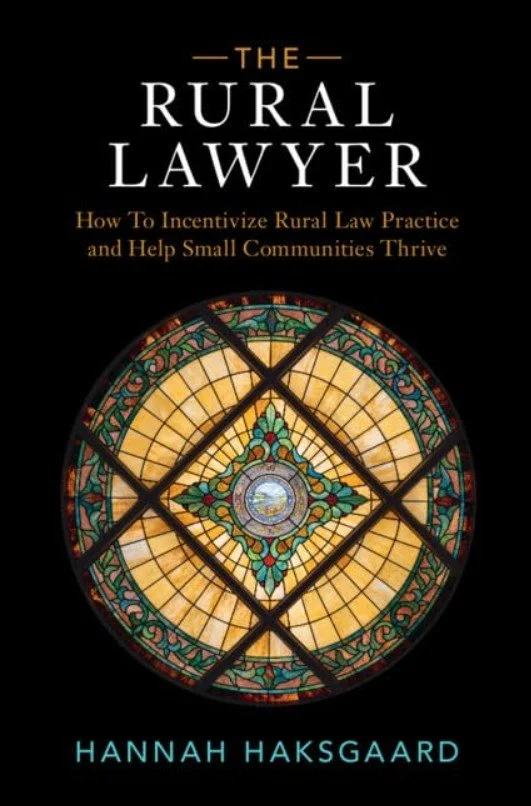
Sarah Vogel shares this review of Hannah Haksgaard’s The Rural Lawyer: How To Incentivize Rural Law Practice and Help Small Communities Thrive (Cambridge UP, 2025)
In William Shakespeare’s drama 2 Henry VI, a character says, “The first thing we do, let’s kill all the lawyers.” This phrase has been used many times to deride the legal profession. But criticism of lawyers wasn’t the intention behind the Shakespearean villain’s suggestion. Rather, he meant that the lawyers had to be killed so that the villains could accomplish their evil objectives.
Forty years ago, in a dissent, US Supreme Court Justice John Paul Stevens explained the “kill all the lawyers” phrase indicated “a step in the direction of a totalitarian form of government.” In May 2025, US District Judge Beryl Howell described a Trump executive order that targeted prominent law firms as being drawn from “a playbook as old as Shakespeare.” From time to time, other judges have used the phrase when laws or policies that restricted access to legal services threaten freedom of speech and association and the right to counsel.
But there is a starker problem in rural areas of the United States. In rural America, there are too few lawyers. Many towns and counties have no lawyers at all. This is a severe and worsening problem as small towns and rural counties depopulate due to multiple factors in agriculture and rural life.
However, despite many challenges, South Dakota has been a pioneer in supporting and enhancing the delivery of rural legal resources. And now there is a new book on South Dakota’s initiatives, aptly titled, The Rural Lawyer: How to Incentivize Rural Law Practice and Help Small Communities Thrive by Professor Hannah Haksgaard of the University of South Dakota Knudson School of Law.
The origin of The Rural Lawyer, as Haksgaard explains in her introduction, was a 2022 conference in Fort Pierre (population 2,115) about strengthening rural communities. The day ended with a dinner where one of Haksgaard’s tablemates, a small-town librarian, asked her how the library could avoid risk of potential liability when asked to host community events. Saying “no” wasn’t an option for the librarian (the library was the town’s only place to gather), but she also didn’t want to incur unnecessary risk for the library. As news spread that a law professor was in attendance, many others posed legal questions: Where can a proposed housing authority get guidance on the type of deed needed to acquire land? Should the volunteers in a community revitalization effort in a rural South Dakota county become organized as a for-profit or a non-profit corporation? Should a particular initiative become a project of the county government or city government? As the evening proceeded and the questions stacked up, it became clear to Haksgaard that each hometown needed a local lawyer to help these communities achieve their goals.
The next day, by happenstance, she visited with David Gilbertson, the retired Chief Justice of the South Dakota Supreme Court. Justice Gilbertson told her about a South Dakota initiative called the South Dakota Rural Attorney Recruitment Program (SDRARP) that had started in 2013 and dealt with many of the legal needs of rural communities. Professor Haksgaard’s interest was captured, and she was off and running.
In what is equivalent to the speed of light for a serious book about law, Professor Haksgaard completed research on the first decade of the SDRARP’s operation, interviewed scores of people, gathered massive amounts of data, wrote and edited multiple drafts and published The Rural Lawyer. To summarize, this book recounts South Dakota’s efforts to provide justice, fairness, and equity for residents of rural communities by incentivizing the practice of law as one of the critical components for economic and social success of rural citizens and rural towns and counties.
The body of the book is divided into deeply researched chapters about the experiences of the lawyers and clients who participated in the first decade of the SDRARP program. Chapters deal with discrete topics such as the finances of a rural practice, types of mentorship, and how to overcome the challenges a stranger will face when moving to and starting a law practice in a rural community where everybody knows everybody since childhood (the answer is to join every community organization and have kids in public schools).
The Rural Lawyer is a scholarly analysis (with 331 footnotes!) but it is also skillfully written and eminently readable. It describes work that has been done, but it is also a roadmap for further efforts and initiatives by South Dakota agriculture, legal, and community leaders. One of the thorniest remaining problem areas is delivery of legal services on Native American reservations.
This book doesn’t have the drama of a John Grisham novel, but it is nonetheless a fascinating deep dive into civil and criminal legal work and the nitty gritty of the business aspects of the practice of law in rural towns and counties. My first legal job was in New York City, and it presented far fewer challenges than those faced by the rural lawyers featured in this book. Nonetheless, most of these lawyers found success.
When I finished The Rural Lawyer, I went back to re-read the introduction. Haksgaard’s introduction includes a lyrical description of why she cares about rural spaces and rural people and why she believes that lawyers are important allies in helping small communities survive and thrive. The Rural Lawyer is not aimed solely at lawyers, however; it is aimed at everyone who cares about the survival of rural communities.
North Dakota and South Dakota are sister states, but we are also competitive. For example, we both claim to have the best badlands. (Out-of- staters are often mystified why either state would brag about having the “best” badlands.) But I must admit that South Dakota is the leader in supporting rural lawyers for rural people. North Dakota is trying to catch up and since 2021 has its own Rural Attorney Recruitment Program.
It is a treat to read a book about law that has the potential to be a gamechanger for rural people. This is that kind of book. I recommend it.
This post is part of our growing book review series. Explore more reviews and book conversations in our new Books section.