Book Review: Farmers and Climate Change
Book Review and Commentary by Laura-Anne Minkoff-Zern.
Laura-Anne Minkoff-Zern is an Associate Professor of Geography and the Environment at Syracuse University. A human geographer and food systems scholar, Minkoff-Zern’s research and teaching broadly explores the interactions between food and racial justice, labor movements, and transnational environmental and agricultural policy. She is coauthor, with Teresa M. Mares, of Will Work for Food: Labor Across the Food Chain (UC Press, 2026).
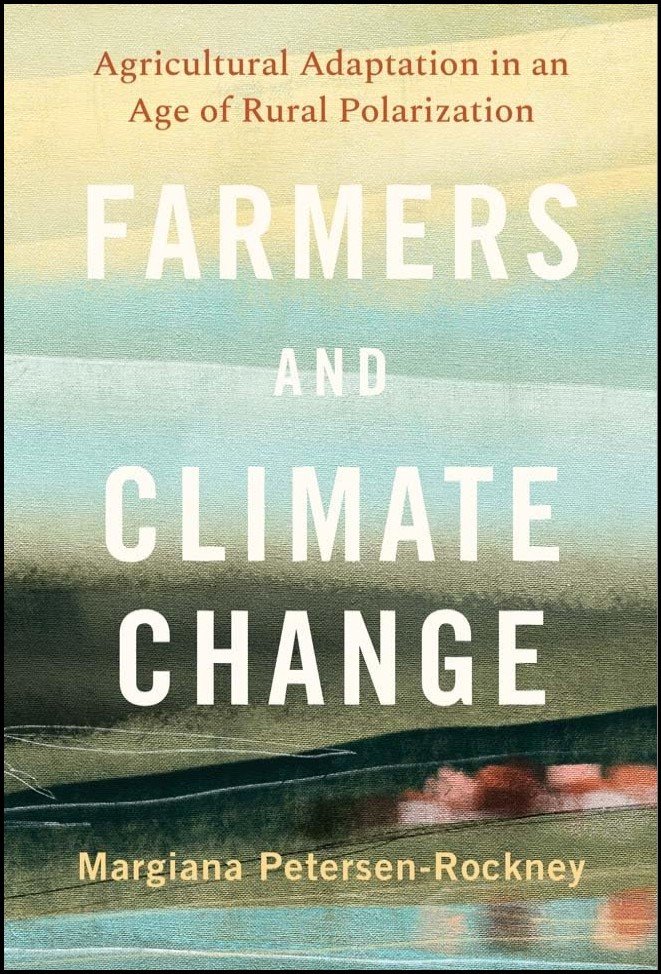
Laura-Anne Minkoff-Zern shares this review of Margiana Petersen-Rockney’s Farmers and Climate Change: Agricultural Adaptation in an Age of Rural Polarization (Yale UP, 2026)
In this timely new book, Petersen-Rockney shares the stories of farmers contending with climate change in Siskiyou County, California, providing new perspectives that will be of interest to scholars, advocates, and policymakers working at the intersection of rural livelihoods and modern day environmental precarity. She highlights an important paradox: while farmers have intimate experience of climate change and are adapting and responding to related risks in their daily lives, many also repudiate the broader context driving these changes. Diving into this contradiction, where agrarian practitioners are making practical changes while avoiding the reality of scientific consensus, this book teaches readers how to reach people where they are by challenging public and political assumptions made at the urban and rural divide concerning environmental values, knowledge, and practices.
Farmers and Climate Change makes an intervention into the literature on agriculture, politics, and rural livelihoods, providing an in-depth study of a diverse set of farmers in Siskiyou County, California. These farmers are diverse in their farming practices, racial and ethnic identities, class positionality, sexual orientation, and perspectives on environmental degradation. Petersen-Rockney argues that by taking seriously the perspectives and practices of farmers and understanding how they can simultaneously respond to and reject the notion of climate change, readers can better imagine necessary future climate-related adaptations. This book provides a deep and complex ethnography and critical contribution, balancing the practical and conceptual. From discussions of soil fertility to community exclusion and political discourse, readers enter a world both focused on the day to day and the long term, including the economic and regulatory structures farmers are contending with as climate change accelerates.
In contrast to accounts of climate change which demonize farmers and other rural producers, this book engages the knowledge and skills of those committed to an agrarian life. In doing so, we learn about their lived experiences, their complex perspectives and politics, and ultimately understand them as important protagonists in seeking climate solutions. As a place-based analysis, the book shares the political history of Siskiyou County to help readers process the county’s specific context and land-based identity, politics, and struggle. We first learn about the regulatory context that has driven many farmers and other rural people to be skeptical of government intervention, and the ways in which they feel othered by policy makers and politicians, reflecting their frustration that power is seated in urban spaces. In particular, these smaller-scaled farmers expressed frustration with California-specific regulations concerning groundwater use and federal regulations such as the Endangered Species Act. They largely felt that smaller operations were beholden to the same standards as corporate agriculture despite a lack of resources and staff to contend with the ongoing bureaucracy. By explicating this spatial divide, geographically and politically, Petersen-Rockney sets the context for a sympathetic view of farmer realities.
While agrarian examples from California have always had much to tell us about the broader context of US agriculture, the state’s farmers also face different realities than most farmers in the rest of the country, from scale of production to resource struggles and the state’s political and land-based history. More could have been directly stated about how this specific regional history fits into the broader US and global context and how it applies to readers working in other regions or broader policy struggles. That said, the final chapter outlines farmers’ resentment of regulation and outsider identity in US politics (despite their relative cultural power) and makes important suggestions as to how such frustrations apply at a broader level. This includes developing regulations which take account of differences in scale, resources, and practices among farmers, as well as supporting existing adaptation efforts. The author makes the case that farmers can and should be part of a broad-based set of climate solutions and be respected by policy makers for their land-based knowledge.
Yet the manuscript is not limited to a stereotype of a farmer or one political persuasion. The story is as much about the importance of diverse farmer identities as it is about farmer practice and politics. By framing farmers’ challenges within a broader focus on identity, Petersen-Rockney shows us how race, gender, and sexuality can also be part of finding climate change solutions, making a contribution to conversations regarding how to shift agricultural practices by confronting the lack of a singular farmer identity. She argues that when farmers already identify as outside of mainstream agrarian social networks and norms, they are more likely to be willing to take risks in their farming practices. Paying attention to social difference allowed the author to find farmers using alternative practices and creating new realities, even in this rural and largely conservative region.
This book is ultimately a story of adaptation, where the goal is to convince readers to not underestimate farmers’ motives and capacity for change in the face of struggle. While farmers may resist government regulation, they are willing to make changes when they see concrete benefits and feel that their needs are heard. Perhaps most notably, the final chapter discusses unlikely alliances between farmers and Native tribes and offers an unpacking of the monolith of rural people and their needs, beginning with their experiences at the front line of environmental catastrophe. This narrative of land-based change rooted in lived experience is crucial to understanding how to reimagine a sustainable climate future; as Petersen-Rockney aptly writes, “The micropolitics of climate adaptation offer spaces in which to contest divergent futures and cultivate transformation” (p.181).
This book, and the lessons learned from farmers themselves, should inspire not just technical changes or short-term agricultural recommendations, but a vision for a more inclusive democracy where rural people are included in policy making and the political process.
This post is part of our growing book review series. Explore more reviews and book conversations in our new Books section.