Commentary: Locked Out: An Examination of Public Land Access Challenges in the American West
Commentary by Erika Allen Wolters and Kevin Pirch
Erika Allen Wolters is Associate Professor in Political Science and Associate Director of the Water Resource Policy and Management Graduate Program at Oregon State University. She is the editor, with Brent S. Steel, of The Environmental Politics and Policy of Western Public Lands (OSU Press, 2020) and When Ideology Trumps Science: Why We Question the Experts on Everything from Climate Change to Vaccinations (Praeger Publishers, 2018).
Kevin Pirch is Professor of Political Science at Eastern Washington University and past President of the Pacific Northwest Political Science Association. His research interests reside in Washington State politics, voting behavior and US elections. He has published articles on vote-by-mail in Washington State, on how income inequality influences state legislatures’ behavior, and other articles on voting behavior among various socioeconomic groups.
Like all Commentary here on the Rural Review, this post expresses the personal opinions of the authors.
Corner Crossing
Iron Bar Holdings, LLC v. Cape, 2025
As the United States expanded its territory into the American West, the federal government’s distributive land policies helped promote settlement by incentivizing new residents with the promise of land, resources, and profit. While these policies, like the Homestead Act, helped entice settlers (and simultaneously displace Indigenous peoples), large-scale infrastructure projects such as the expansion of railways aided western settlement. However, the federal government retained a significant amount as public land, allocating it based on the Public Land Survey System (PLSS). The PLSS neatly mapped the region into 640-acre sections, resulting in a checkerboard pattern of public and private land ownership. This intermix of land ownership led to expected quarrels over natural resource use, ownership, and private property rights. Additionally, it also left about 9.52 million acres of the 640 million acres of public land total in the United States inaccessible for public use.
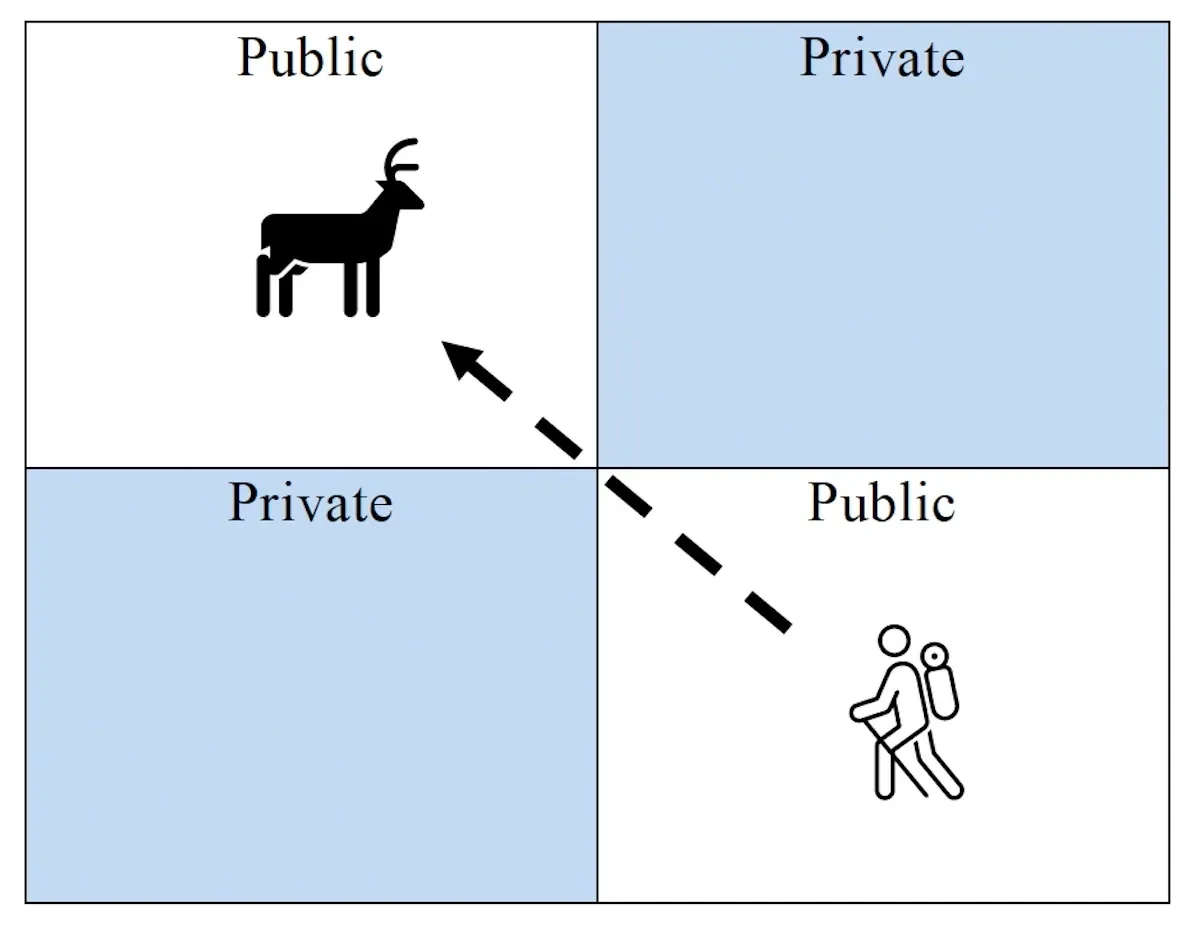
There are two ways public lands are inaccessible: they are either isolated or corner locked. An isolated parcel is one that is completely surrounded by private land with no public access points. A corner-locked parcel is one where two public land parcels meet only diagonally, at a corner, with private land bordering to either side. These corner-locked areas of intermixed (or checkerboarded) public and private land ownership have created legal and practical challenges to public access. A recent case involving four hunters in Wyoming challenged the legality of “corner crossing” (briefly crossing the airspace above the private land at the intersecting corner to access public land). The hunters were charged with criminal trespass and faced a civil liability case for $9 million. While all four hunters have been cleared of all charges, the case warrants a closer investigation as it exemplifies the conflict over public access to public lands across private spaces. Further, it is a harbinger for future cases involving the public’s right to access public lands via private spaces.
Access and Corner Crossing
Elk Mountain Ranch in Wyoming, owned by Iron Bar Holdings, LLC (referred to as Iron Bar), occupies over fifty square miles of land in southern Wyoming’s Carbon County. Included in the property is part of Elk Mountain, aptly named for the large populations of elk which reside in the region. Iron Bar is not one uniform, contiguous property. Twenty-seven separate parcels of public land managed by the Bureau of Land Management (BLM) or the state of Wyoming, totaling 11,000 acres or about 17 square miles of land, are interspersed within its boundaries. In many places around the ranch, like much of the West, the parcels of public and private land are arranged in a checkerboard fashion, meaning that the only way to cross from one section of public land to another without overtly trespassing is at the corner of the land where all four parcels intersect.
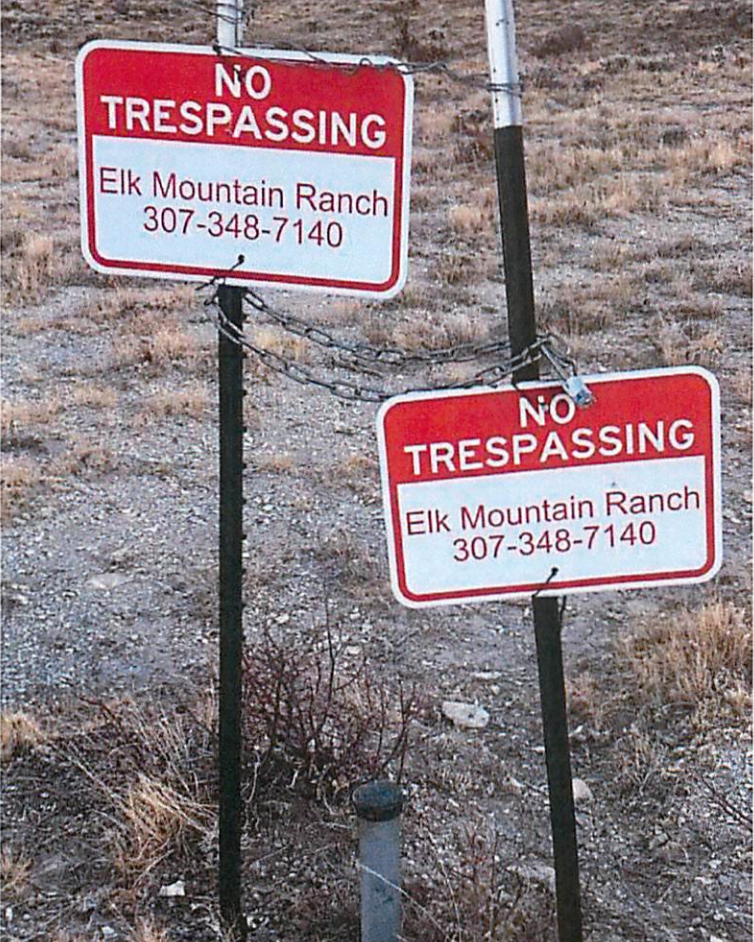
In the fall of 2020, four men traveled from Missouri to Elk Mountain, Wyoming to hunt on the BLM lands located within the 50-square-mile ranch. The men set up camp on a parcel of public land accessible using a public road, using GPS technology to remain on public lands until the first marked corner signifying the intersection of the public and private lands. At this corner, Iron Bar had staked “No Trespassing” signs on each parcel of private property and connected them with chains, impeding the hunters’ ability to cross from one corner of public land to the next.
Iron Bar Holdings, LLC. Posted Trespass Signs
Thuermer, WyoFile, 2021
To circumvent this and continue to their hunting grounds, members of the party used the stakes to swing around from one parcel of public land to the opposing parcel. While at no time did any of the hunters touch the surface of the private property, they were in the ranch’s airspace for a fleeting moment. When the managers of Iron Bar found the hunters on another section of public lands, they confronted the hunters and demanded that they leave the area. The hunters refused and when law enforcement was called, the officers refused to charge them.
The same hunters returned to Elk Mountain in 2021, bringing a small ladder with them to cross over the corners and avoid touching any part of the private land or signs (essentially only traveling in the airspace of the ranch property). This time, the ranch managers were allegedly more aggressive: they tried to chase the hunters off the public land and contacted both the sheriff’s office and the Wyoming Game and Fish Department. Again, neither agency would pursue trespassing charges against the hunters. The local prosecutor’s office, however, did file criminal trespass charges at the urging of Iron Bar. This too, was unsuccessful, resulting in the jury finding the hunters not guilty. In addition to these criminal charges, Iron Bar brought a civil suit against the four men for $9 million, alleging that their trespassing significantly decreased the value of the ranch. In a summary judgement, the district court ruled in favor of the hunters, and the decision was then appealed to the United States Court of Appeals for the Tenth Circuit.
In examining the case, the appellate court had to decide if the hunters, who never set foot on the ranch property but did enter the airspace of the ranch, could be charged with trespassing. The Court decided that while violating the airspace of private property is a trespass according to Wyoming laws, there were federal laws that superseded Wyoming statutes, specifically the Unlawful Inclosures Act (UIA) of 1885. The UIA was designed to address the tactics used by many of the eras’ cattle barons to prevent the public from accessing the public lands of the West by either fencing off public lands or by using threats or actual force to prevent people from accessing the land. To prevent private landowners from engaging in these practices, the law prohibits “the maintenance, erection, construction, or control of any such enclosure . . . and the assertion of a right to the exclusive use and occupancy of any part of the public lands of the United States,” and goes on to state that:
“No person, by force, threats, intimidation, or by any fencing or inclosing, or any other unlawful means, shall prevent or obstruct, or shall combine and confederate with others to prevent or obstruct, any person from peaceably entering upon or establishing a settlement or residence on any tract of public land subject to settlement or entry under the public land laws of the United States, or shall prevent or obstruct free passage or transit over or through the public lands . . . .” (43 USC 25 §1061)
In their decision, the Court found that the language in the UIA prohibits not just fencing in public lands but enclosing the lands or obstructing access to the land in any way and that the federal law supersedes any state laws regarding trespassing. Because of this, the hunters’ actions were legal and there was no basis for the civil trespassing case.
Not ready to back down, Iron Bar petitioned the Supreme Court to hear the appeal. The Supreme Court denied certiorari, thereby leaving in place the decision from the Tenth Circuit Court of Appeals, effectively preserving access to “more than 3.5 million acres of public lands in Wyoming, Colorado, Utah, New Mexico, Kansas, and Oklahoma, with implications for an estimated 8.3 million acres across the West”. While the decision leaves the appellate ruling in place in the Tenth Circuit and provides precedent for future trespass challenges, it is likely the issue will continue to be contested in other Western states and potentially in other federal circuits.
Seeking a Remedy: Public Access Federal and State Efforts
The corner-crossing case highlighted the importance of addressing and clarifying federal public land access and is part of a broader conversation about how the federal and state governments could potentially mitigate the issue. In 2019, the federal government, through bipartisan action and President Trump’s signature, passed the John D. Dingell, Jr. Conservation, Management, and Recreation Act, which permanently reauthorized funding for the Land and Water Conservation Fund (LWCF). The LWCF sets aside funding to increase access to public lands and requires federal land management agencies to identify land currently inaccessible to the public. Further, in 2020, the Great American Outdoors Act allocated $900 million annually to the LWCF, which is used, in part, to increase public access to federal public lands.
While the federal government maintains responsibility for access to federal public land, states have also weighed in on access to state trust lands—lands that were bequeathed to the states from the federal government when they joined the Union. At present, there are approximately 6.35 million acres of state lands inaccessible to the public. While states may have a fiduciary responsibility to manage this land for economic resources, there has been a move away from a traditional extractive economy to recreation and the service industry economies, highlighting the increased social and economic value of state public lands. As a result, some Western states are enacting legislation addressing issues of access, liability, and trespass.
In part due to the allocation of public and private land by the PLSS, landowners whose property is adjacent to or surrounded by public lands can make public access challenging by locking access gates or using other means to block access. In response, places like Arizona, Montana, and Nevada, have criminalized blocking access to state and federal public lands, specifically prohibiting building fences, locking gates, and devising other means of obstruction.
| State | Legislation/Initiative | Legal Access Requirements |
|---|---|---|
| Arizona | Ariz. Admin. Code § R12-4-110 | Prohibits use of obstacles such as fences, locked gates, or other barriers to obstruct access to state lands roads. Authorizes corrective action to remove obstructions or potential fines. |
| Montana | HB 486 (2023) | Increases penalties (no less than $100 and no more than $500/day) for illegally blocking public roads or access to public lands. |
| Nevada | SB316 (2019) | Revises provisions governing public nuisances to include the blocking of public passage to public lands and roads. Civil penalty between $500-$5000. |
Other states have used a carrot rather than a stick (or both) by providing economic incentives for landowners to permit access to state public lands. Idaho, Montana, and New Mexico each offer financial incentives to landowners to allow the public rights of access to state lands. In Montana, a private landowner could receive up to $15,000 per agreement for providing access rights.
| State | Legislation/Initiative | Access Incentives |
|---|---|---|
| Idaho | Access Yes | Incentivizes landowners to provide access to private property, or through it, to reach public land for hunting and fishing. |
| Montana | SB 341 Public Access to Lands Act (PAL) (2019) | Fish, Wildlife & Parks negotiate financial incentives for landowners to provide public access across private land for recreation. |
| New Mexico | Open Gate Program | Financial incentives for leasing private land to provide public hunting, fishing, trapping, and access to public land. |
Importantly, there are many landowners who would like to allow access to public lands but worry about their liability should a member of the public be injured or killed. Every state has some liability protection laws, but these laws vary widely and many landowners remain concerned about potential lawsuits. For example, both Colorado and Oregon have liability protections for landowners when access is granted free of charge to the public. In addition, Oregon State Senators Mike McLane and Anthony Broadman introduced bipartisan legislation clarifying the legality of corner crossing to allow public access and reduce landowner liability (S.B.1545, 2026). While this bill is currently in committee, it furthers the conversation about corner-crossing access and landowner liability in order to potentially free up more points of access for the public.
| State | Legislation/Initiative | Liability and Access Protection |
|---|---|---|
| Colorado | Colorado Recreational Use Statute (2024) | Protects landowners from liability issues related to access for recreational purposes. |
| Oregon | SB 1545 (2026) - pending | Clarifies corner crossing laws, protects landowners from liability and hunters, anglers, etc. from trespass. |
| Oregon | ORS 105.682 | Protects landowners from liability issues related to access for recreational purposes. |
Compounding the issue of access, federal public lands (and some state public lands) currently lack the resources necessary to maintain trails, roads, and infrastructure. In 2022, the Modernizing Access to Our Public Lands (MAPLand) Act was enacted to use geographic information system data to collect and identify areas, including easements and rights-of-way, available for public use. While this technology can clarify public access, using tools like the Land and Water Conservation Fund to acquire access easements can help to open areas currently locked up from the public (as well as provide funding for the maintenance of roads, trails, and infrastructure). Attempted safeguards will, inevitably, be challenged in future legal disputes, but state and federal efforts working to clarify issues around liability, trespass, access, and use will hopefully help to mitigate current barriers to public land access.
Conclusion
The checkerboard fashion of land allocation throughout the American West which occurred over 150 years ago defies modern logic. In creating this system, more than 9.5 million acres of federal public land (and 6 million acres of state lands) became inaccessible to the public. However, given the strong bipartisan public support for public lands – in a 2025 survey, the Trust for Public Land found that around 74 percent of Americans oppose selling public land, instead wanting more access – it appears there is a mandate for more access. To solve the problem of inaccessibility requires a good faith effort among public land management agencies, landowners, the public users and can take decades to negotiate. The corner-crossing case was a win for public land access but is by no means the end of the story. Challenges around ownership, management, access, and use will continue into the foreseeable future as the demographic, economic, and environmental landscape continues to shift. What is clear is a strong mandate that can provide a guidepost to future policies and strategies to protect and conserve public lands.
Continue the conversation!
The Rural Reconciliation Project welcomes similar contributions from a range of rural and non-rural voices here on the Rural Review.
Find our submission guidelines.